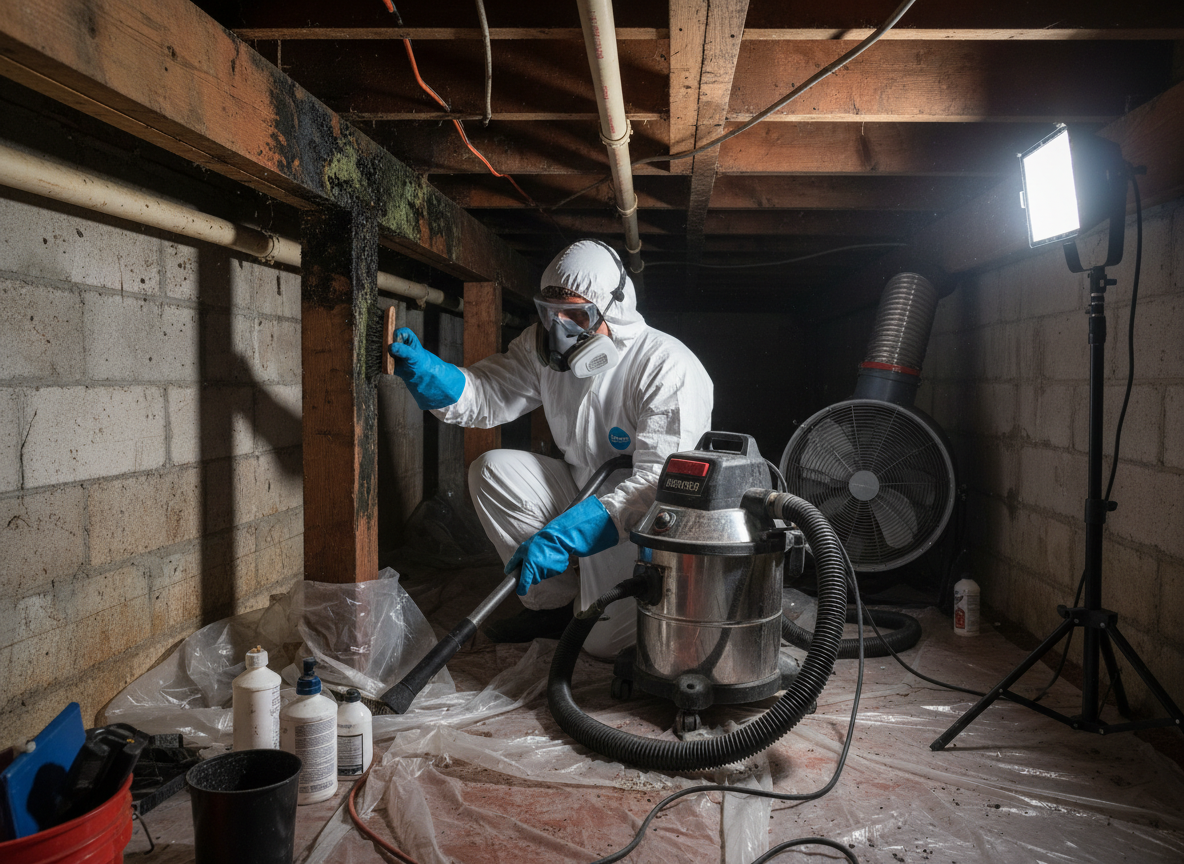
Tujunga sits in the San Gabriel foothills with many homes built before 1960 that feature vented crawl spaces sitting close to grade. Winter rains funnel water along Tujunga Wash and natural drainage paths from Angeles National Forest, saturating soil against foundation walls. Once moisture enters the crawl space it lingers because summer heat dries the surface while trapping humidity below the floor joists. Mold colonies form on subfloor sheathing and insulation, then release spores into living areas through gaps around plumbing penetrations.
Removal begins with containment using plastic sheeting sealed to the foundation and joists to keep spores from migrating into Sunland or Sylmar-adjacent homes. Technicians remove wet insulation, treat affected wood with EPA-registered antimicrobials, and improve airflow with temporary dehumidification tied to exterior exhaust. In Shadow Hills properties built on sloped lots, crews often discover mold extending into rim joists where grading directs runoff under the structure. Final clearance testing confirms spore counts match outdoor levels before any new insulation is installed.
Local code in Los Angeles County requires vapor retarders and adequate ventilation when crawl spaces are encapsulated after mold work. Homeowners in Bolton Hall Museum historic districts must also coordinate with preservation guidelines that limit certain sealants. Skipping these steps leaves residual moisture that returns with the next mild winter storm. Proper documentation of pre-existing conditions protects both the property owner and the restoration crew when insurance adjusters review claims from Foothill Trails addresses.
Technician insight
In Tujunga the thing that catches most people out with crawl space mold removal is the way mild winter rains soak the soil against older pier-and-beam foundations in Tujunga Village while the hot dry summers bake the surface dry, hiding active growth under the subfloor until it reaches the living space.
Foothill Trails Home After Heavy Rain
Water entered a 1950s crawl space near Tujunga Wash after winter storms. We found mold on insulation and rim joists where drainage from Angeles National Forest pooled against the foundation. Crews removed wet materials, treated the wood, added a vapor retarder, and dried the space. Spore levels returned to outdoor norms and the homeowners reported no further musty odors upstairs.
How it works
- 1
Initial Assessment
Technicians inspect the crawl space from the 6350 Foothill Blvd base, checking soil moisture, wood moisture content, and visible growth while noting drainage patterns from nearby Tujunga Wash.
- 2
Containment Setup
Plastic barriers are sealed to joists and foundation walls to isolate the work zone before any materials are disturbed.
- 3
Removal and Treatment
Wet insulation and affected wood are removed, surfaces are cleaned and treated, then dehumidifiers and air movers dry the space.
- 4
Ventilation and Clearance
Vapor retarders are installed where needed and post-remediation testing confirms the space meets outdoor spore levels before homeowners re-enter.
Pricing
Cost depends on square footage accessed, amount of insulation removed, and whether rim joist work is required on sloped foothill lots.